Hello I’m Dr. Lee! Numbers on a dental chart can be hard to connect to real experience. When your periodontist measures your keratinized gingiva width and tells you it’s 1 mm or 3 mm what does that actually mean for your daily life, your comfort, and your long-term gum health?
Keratinized gingiva width is the measurement of the firm, tough band of protective gum tissue that sits closest to your teeth. It is one of the most clinically meaningful numbers in periodontics, and understanding how it changes before and after different types of gum surgery — helps you evaluate your treatment options with real clarity. In this post, we walk through three patient scenarios that illustrate what keratinized gingiva width looks like before treatment, how surgery changes it, and what the long-term picture shows.
What Keratinized Gingiva Width Actually Measures
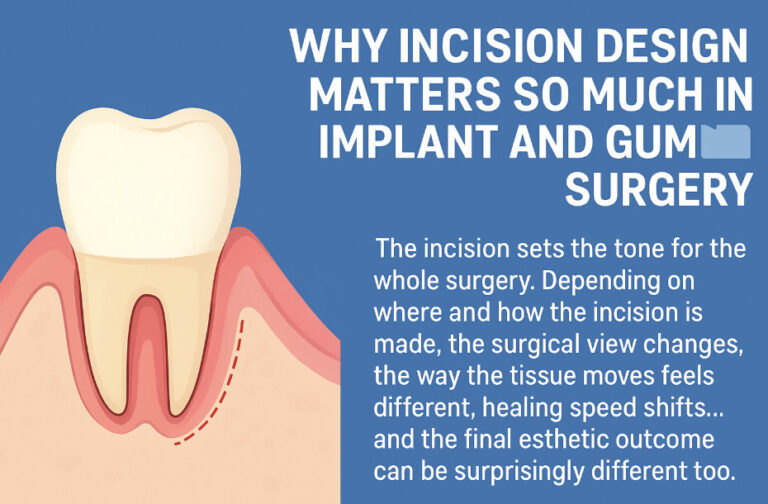
Before diving into the cases, a quick orientation. Your gum tissue is not uniform. The firm, pale pink tissue immediately surrounding your teeth — the tissue that resists mechanical forces without tearing — is called keratinized gingiva. Below that, the tissue transitions into softer, more elastic mucosal tissue that lacks this protective toughness.
Keratinized gingiva width measures how wide that firm, protective band is, in millimeters. A width of around 2 mm or more is generally considered adequate for long-term stability. Below that threshold, the gum margin becomes more vulnerable to recession, sensitivity, and breakdown particularly under daily brushing forces.
Case One — Thin Band, Fully Covered Graft
Before Treatment
A patient in her mid-thirties presents with visible root exposure on two lower front teeth. Keratinized gingiva width at the affected sites measures 0.5 to 1 mm well below the threshold for stable long-term protection. The recession depth is moderate at 2 to 3 mm.
She has a naturally thin gum biotype, and her tissue is delicate enough that the underlying bone contour is faintly visible through the gum surface.
Treatment and Immediate After
A connective tissue graft is placed using the coronally advanced flap technique the graft is fully covered by an overlying tissue flap. Root coverage at the six-week follow-up is excellent. The recession is almost completely reversed and the cosmetic result is clean and natural-looking. However, keratinized gingiva width at the treated sites shows minimal increase measuring approximately 1 to 1.5 mm, only marginally wider than before surgery.
Long-Term Follow-Up
At the three-year follow-up, something notable has occurred. Without any additional intervention, the keratinized gingiva width has gradually increased to approximately 2.5 to 3 mm. The natural boundary between tough and soft gum tissue has slowly migrated toward its genetically preferred position, widening the protective band in the process. Root coverage remains stable. The patient reports no sensitivity and has maintained good oral hygiene throughout.
What this case illustrates: the fully covered graft technique delivers excellent cosmetic root coverage immediately, but the meaningful gain in protective tissue width develops gradually over years rather than immediately after surgery.
Case Two — Very Thin Band, Partially Exposed Graft
Before Treatment
A patient in his late forties presents with gum recession on three upper teeth. Keratinized gingiva width is less than 0.5 mm at the most affected site effectively almost no protective band exists. The recession is deeper, measuring 4 to 5 mm.
His periodontist notes that the extremely limited keratinized tissue makes this a higher-risk case for long-term stability regardless of root coverage achieved.
Treatment and Immediate After
A connective tissue graft is placed using the envelope technique, intentionally leaving the uppermost portion of the graft exposed rather than covered. Root coverage at six weeks is slightly less complete than in the fully covered case approximately 80 to 85% of the recession is covered rather than close to 100%.
However, keratinized gingiva width at the treated sites has increased substantially measuring 2.5 to 3 mm, directly corresponding to the area of graft that was left exposed during healing.
Long-Term Follow-Up
At three years, keratinized gingiva width has remained stable at approximately 3 mm. The partial root coverage has not worsened. The patient reports that his primary concern sensitivity during eating and brushing has resolved completely, which he attributes to the wider band of protective tissue around the affected teeth.
What this case illustrates: deliberately leaving part of the graft exposed trades some immediate root coverage completeness for a significantly wider band of protective tissue a trade-off that makes clinical sense when the pre-treatment keratinized tissue width is critically low.
Case Three Adequate Band, Monitoring Without Surgery
Before Treatment
A patient in her early fifties presents with mild recession affecting two teeth. Keratinized gingiva width measures 3 mm at both sites above the threshold for concern. Recession depth is shallow at 1 to 1.5 mm. Her periodontist notes the recession but recommends monitoring rather than immediate surgical intervention, given that the protective tissue band is adequate and the recession is not progressing rapidly.
Eighteen Months of Monitoring
With improved brushing technique, a switch to a soft toothbrush, and more frequent periodontal maintenance appointments, the recession does not progress further over eighteen months. Keratinized gingiva width remains stable at 3 mm.
The patient is counseled that surgery remains an option if recession progresses, but the current clinical picture does not require it.
What this case illustrates: keratinized gingiva width above the threshold is protective in itself. Not every case of mild recession requires immediate surgical intervention — and when the protective tissue band is adequate, conservative management can be a reasonable first approach.
The Pattern Across All Three Cases
Looking at these cases together, several consistent themes emerge. Keratinized gingiva width below 1 mm almost always warrants surgical attention, regardless of the root coverage technique chosen. The choice between a fully covered and partially exposed graft directly shapes how much protective tissue width is gained immediately after surgery.
And in cases where tissue width gain is modest at first, the body’s long-term natural tissue maturation process may deliver meaningful additional width over years though this cannot be relied upon as a substitute for adequate initial tissue volume.