
Hello I’m Dr.Lee! Bruxism refers to the repetitive act of grinding or clenching teeth. It is a condition that affects jaw joint health and can lead to serious dental issues if left untreated. In a broad sense, the act of clenching or grinding teeth from the time you are awake until you go to sleep is considered a disease. Early detection through bruxism self-diagnosis is important, and using a night guard is one of the commonly recommended bruxism treatment methods. Understanding the causes of bruxism can help in preventing long-term damage.
Causes of teeth grinding
The cause of bruxism has not been clearly identified. However, various perspectives on the cause have been pointed out.
Psychological factors such as stress, anxiety, or depression, sleep disorders, brain disorders, smoking or drinking, gaps between teeth, crooked teeth, and jaw joint disorders (symptoms like pain while chewing, misaligned jaw joints, and difficulty opening the mouth) are known causes of bruxism.
Even though they are aware that the teeth grinding is severe, many people think of it as a sleeping habit and leave it untreated.
Bruxism involves grinding teeth sideways or clenching them up and down, which puts a lot of strain on the teeth and jaw joints. If you overlook the issues with the jaw joints and teeth that are bearing the load, various problems can arise, affecting your overall jaw joint health.
The problem of teeth grinding
Cracks, fractures, wear, cavities between teeth, and sensitivity throughout the teeth can occur. The jaw joint muscles can also be strained, leading to jaw joint hypertrophy, muscle inflammation, or even facial asymmetry.
Before it becomes the cause of various problems, I recommend treating bruxism.
Bruxism treatment methods
From now on, I will write about the treatment methods for bruxism. There are two main bruxism treatment methods.
1. Teeth grinding prevention device : nitght guard
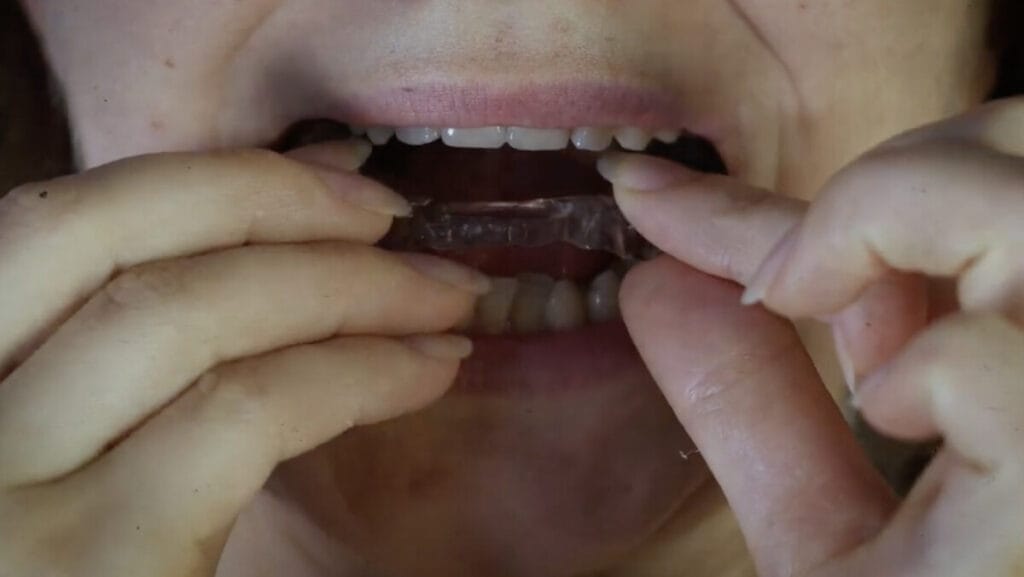
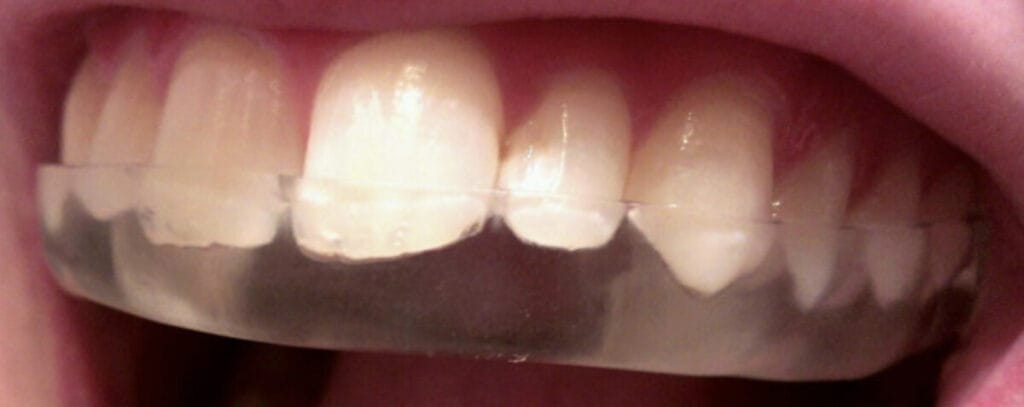
The first is a teeth grinding prevention device. This protective device, commonly known as a night guard, resembles an occlusal stabilizing device (sprint).
By wearing it in your mouth before sleeping, you can prevent tooth wear and also protect your jaw joints, thus improving jaw joint health.
I also have a habit of grinding my teeth. Especially during stressful times, I’ve often woken up after clenching my teeth. So, every time, I wear a night guard. You just put it on your upper teeth and sleep.
This device is not a tool that corrects bruxism itself. It simply prevents tooth damage caused by grinding.
However, there might be some discomfort in having to wear it on your teeth every day while trying to sleep. If you are sensitive when it comes to sleeping, you might easily feel uncomfortable.
- Precautions when choosing a night guard
It is better not to use the ready-made mouthguards sold online. If someone in my family says they use it, I would definitely tell them not to use it.
The shape of teeth varies from person to person. Wearing a night guard that is different from the shape of your teeth for a long sleep period is dangerous. Our brain will consider a device that doesn’t fit the dental arch as a foreign object.
This can act as stress. In fact, it will likely cause teeth grinding to worsen.
2. Botox
There are also procedural methods.
There are people looking for Botox to improve bruxism. The Botox used for improving bruxism has the same ingredients as the Botox used for cosmetic purposes.
Botox is injected simultaneously into the main muscles used for grinding teeth, the masseter and temporalis. This procedure relaxes the two muscles and also reduces the overall volume.
In short, it is a method that relaxes the muscles by reducing their tension and helps improve jaw joint health.
Since we also inject the temporalis muscle, those who have headaches say their headaches have improved.
If you only get Botox in the masseter area for severe bruxism, the temporalis muscle may become excessively activated. So, when getting Botox to prevent bruxism, we recommend getting it on both the masseter and temporalis muscles.
Botox is not a permanent treatment method.
If you get it regularly every 4 to 6 months, bruxism will improve significantly.
- Precautions for Botox treatment
When you get Botox in the masseter and temporalis muscles, your chewing strength decreases. Since the chewing power weakens, you might find it uncomfortable when eating meat or hard foods.
Some people say that it’s not the same as before because eating is uncomfortable. Even if it requires a bit less chewing power, there is the advantage of preventing tooth damage caused by grinding.
Recommended treatment method
To effectively improve bruxism, it is advisable to choose both methods.
The best results are achieved when using a night guard while managing the muscles with Botox.
It would be good to use a night guard as a basic measure, but aim to gradually reduce the use of Botox.
Bruxism self-diagnosis checklist
- In the morning, when you wake up, your jaw feels stiff.
- My mouth doesn’t open well.
- The entire mouth feels numb or sensitive for no reason.
- When I visit the dentist, I often hear that my teeth are worn down.
- There are bite marks on both cheeks or the tongue.
- Foreign substances like threads come out of the mouth.
- It seems like there are more jaw muscles than before. (When biting down hard, the jaw muscles are very noticeable.)
If you are experiencing three or more of these symptoms, it is necessary to visit a dentist to check if you are grinding your teeth.
Teeth grinding often occurs unconsciously while you are sleeping. As a result, many people are unaware that they are grinding their teeth.
If you have bruxism, we recommend that you visit a dentist and actively seek treatment. If you don’t take good care of your teeth, they will shrink as you age.
To preserve your teeth and maintain jaw joint health, you must have regular dental check-ups. I hope you start taking proper care of them now to maintain your dental health.


